The 7 Days of Creation: A Science Lesson in Disguise
Genesis 1 isn't just theology — it's a complete taxonomy of the natural world. We built an entire science curriculum around it, and the results have been remarkable.
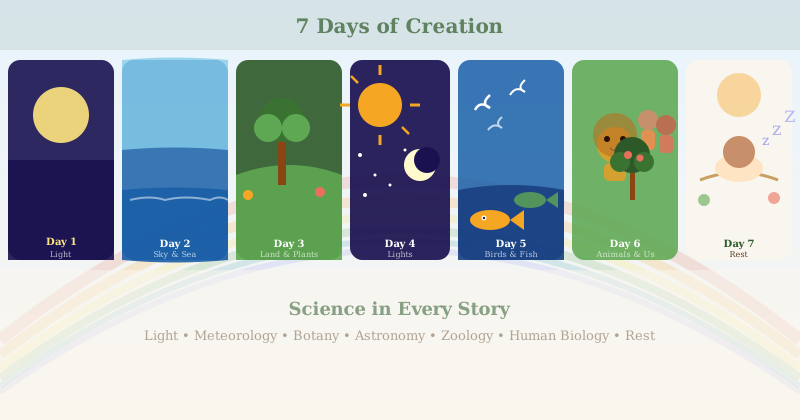
If you read Genesis 1 through a scientist's eyes, something surprising emerges: the seven days of creation are a systematic taxonomy of the natural world.
Day 1: Light and darkness — energy, the electromagnetic spectrum, the physics of visibility
Day 2: Sky and water — the atmosphere, the hydrosphere, the separation of air and liquid
Day 3: Land, sea, and plants — the geosphere, the lithosphere, and the first producers in the ecosystem
Day 4: Sun, moon, and stars — astronomy, time, seasons, the calendar
Day 5: Birds and fish — avian and aquatic life, two of the largest branches of the animal kingdom
Day 6: Land animals and humans — terrestrial life and the introduction of cognition, creativity, and relationship
Day 7: Rest — rhythm, restoration, the Sabbath principle that physical systems require renewal
For a young child ages 4–7, this sequence is an extraordinary teaching tool. It introduces every major domain of natural science in an order that is logical, memorable, and spiritually grounded.
## The Pedagogical Genius of the Creation Sequence
Educational researchers use the term "advance organiser" to describe a conceptual framework given to students before they learn new material. Advance organisers dramatically improve retention and understanding — but they need to be simple enough for children to hold in their heads, and memorable enough to retrieve when they need it.
The seven days of creation is perhaps the most powerful advance organiser ever devised for early childhood science education. Every child in a Christian household already knows it. They've sung about it, coloured pictures of it, acted it out. By the time they encounter formal science instruction, they already have a mental map of every major domain of natural science.
All we have to do is attach the scientific content to the framework they already hold.
## How We Teach It at Little Vine
In Little Vine's Science curriculum, we use the seven days of creation as the structural "map" for a child's understanding of the natural world. Rather than jumping from "insects" to "weather" to "the human body" in a sequence that feels arbitrary to a young child, we anchor every science topic to this framework.
A child who knows the seven days of creation has a mental scaffold for categorising almost anything they encounter:
- A rainbow? That's Day 1 — light, bending through water.
- A thunderstorm? Day 2 — the sky doing what God made it to do.
- A flower pushing through soil? Day 3 — a producer, starting the food chain.
- The changing seasons? Day 4 — the Earth moving around the sun that God set in place.
- A dolphin leaping from the ocean? Day 5 — a creature of the sea.
- A dog sitting beside you? Day 6 — a land animal, sharing the world with people.
This is the beginning of scientific thinking: the ability to categorise, to ask "what kind of thing is this?" and "where does it fit in the larger picture?" Taxonomic thinking is the foundation of biology, physics, chemistry, and earth science. The child who can categorise encounters encounters science not as a series of disconnected facts but as a coherent conversation about one world.
## A Week-by-Week Example: Day 5
In Little Vine's Pathfinders curriculum (ages 6–8), a week on Day 5 of creation — birds and fish — covers:
Monday: Birds
- How birds are different from other animals (feathers, hollow bones, warm-blooded)
- Types of flight: flapping, soaring, gliding
- The dove as a biblical symbol — why Noah sent the dove, what its return meant
- Activity: Build a simple paper glider and observe how wing shape affects flight
Tuesday: Fish and Marine Life
- How fish breathe underwater (gills vs. lungs)
- The ocean as an ecosystem — what lives there, what it needs
- The miracle of the loaves and fishes — two fish feeding five thousand
- Activity: Build a simple paper fish and observe how its shape moves through water
Wednesday: Birds and Fish Together
- What birds and fish have in common (vertebrates, egg-laying)
- The food chain — how birds and fish interact
- Jonah in the belly of the whale — what we know about large marine mammals
- Activity: Draw a marine food chain
Thursday: Care for God's Creatures
- Environmental stewardship as a biblical mandate
- Endangered birds and fish — why they matter
- Prayer for creation
Friday: Review and Create
- Week summary: what we learned about God's creation on Day 5
- Art project: paint or draw a bird and a fish
This is a full week of science — genuine, rigorous, age-appropriate natural science — structured around a single day of creation. The child finishes the week knowing more about birds and fish than most adults can articulate, and they know it because it was connected to something they already loved: the story of God making the world.
## Creation Awareness vs. Doctrinal Narrowness
One concern we often hear from parents and educators: "Does creation-based science education mean you don't teach children about evolution, the age of the earth, or scientific consensus?"
At Little Vine, our science curriculum for ages 2–8 does not engage these debates — not because we are hiding something, but because the developmental science is clear: children under 8 are in what Piaget called the "preoperational" and "concrete operational" stages of cognitive development. Abstract debates about the mechanisms of species change or the age of the universe are genuinely beyond the cognitive reach of a 5-year-old, and introducing them as controversies simply creates confusion.
What we do teach is wonder. We teach children to observe carefully, ask questions freely, name what they see accurately, and understand that the world God made is worth studying in great detail. These are the habits of a scientist. A child who develops them by age 8 will be fully equipped to engage the larger questions when they have the cognitive tools to do so.
## The Unexpected Benefit: Scientific Vocabulary
A consistent finding from families using Little Vine is that children develop unusually rich scientific vocabulary without formal memorisation. Why? Because the vocabulary of Genesis is, by design, the vocabulary of science.
Atmosphere. Luminaries. Vegetation. Creatures. Dominion. Reproduce. These words appear in the creation narrative, and children who know the story know the words — before they know they're scientific terms.
When a child later encounters "photosynthesis," they already know that plants make food from light — because that's what Day 3 plants do. When they encounter "bioluminescence," they know what light is and why it matters — because Day 1 told them. The biblical vocabulary and the scientific vocabulary map onto each other more often than we realise.
## Frequently Asked Questions
Q: Does Little Vine's science curriculum conflict with what children learn in school?
A: No. Little Vine teaches the same domains of natural science taught in any early childhood setting — animals, plants, weather, the solar system, the human body, simple physics. The difference is the framework and the vocabulary used to introduce them.
Q: Is the 7-days-of-creation framework suitable for older children too?
A: Absolutely. The framework scales. For younger children (2–5), it's simply a memorable sequence — "God made light on Day 1, sky and water on Day 2." For older children (6–8), it becomes a taxonomy and an opportunity for deeper scientific inquiry. And for adults, it holds up as a remarkably comprehensive description of the major domains of natural science.
Q: What science content does Little Vine cover across all age bands?
A: Little Vine covers the five senses, plants and animals, weather and seasons, the solar system, the human body, simple machines and physics, ecosystems, and the properties of water and materials — all organised by the creation week framework.
More from the Journal
Why Faith and Learning Belong Together
Modern education separates faith from the classroom. We think that's a mistake — and the research backs it up.…
How Bible Stories Build Early Literacy Skills
The best early readers aren't the ones who practised phonics the most. They're the ones who fell in love with …
Raising Curious, Kind Kids: What the Research Actually Says
Kindness and curiosity aren't traits children are born with or without. They're cultivated skills — and the sc…
Try Little Vine with your family.
11 free games. No account required. See the curriculum in action.