Raising Curious, Kind Kids: What the Research Actually Says
Kindness and curiosity aren't traits children are born with or without. They're cultivated skills — and the science tells us exactly how to cultivate them in children ages 2–8.
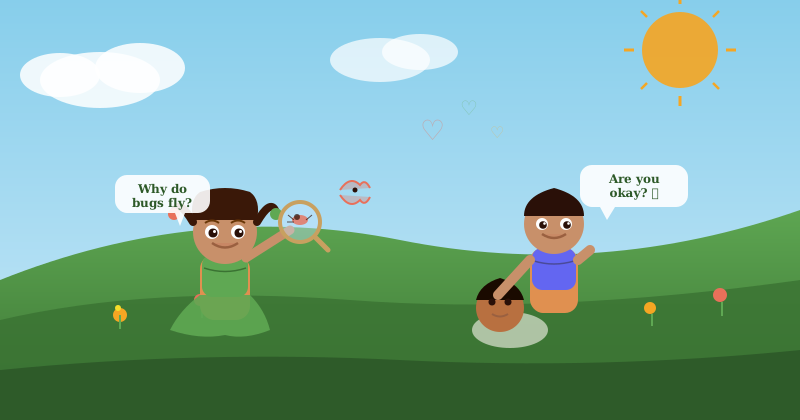
Two of the traits parents most want to cultivate in their children — kindness and curiosity — are often treated as fixed personality characteristics. Either a child is curious or they're not. Either they're kind or they're not.
But the research tells a very different story. Both kindness and curiosity are cultivated skills. They are not randomly distributed at birth. They are developed — or stunted — by the environments children inhabit, the stories they hear, and the habits their families practise.
The good news: both traits respond remarkably well to intentional cultivation in the 2–8 age window.
## Kindness Is a Practised Skill
A landmark 2013 study published in Psychological Science by Kristina Olson and Elizabeth Spelke found that children as young as 4 show significantly greater prosocial behaviour — helping strangers, sharing resources, comforting distressed peers — when they have regular exposure to stories where characters make kind choices and where those choices are explicitly discussed.
This isn't passive absorption. The children who benefited most were not the ones who simply heard kind stories. They were the ones who were asked questions about the characters' choices: "Why do you think Boaz helped Ruth?" "What might have happened if the Good Samaritan had walked past?"
This is the difference between consuming a story and processing it. Children who process stories — who are invited to interpret, predict, and respond to characters' moral choices — develop empathy faster and more durably than those who merely hear stories or receive rule-based moral instruction ("Be kind. Share your toys.").
At Little Vine, every story section includes age-appropriate reflection questions. Not test questions — "What did David do?" — but interpretive ones: "Why do you think David wasn't scared?" "What would you have done?" "How do you think the shepherd felt when he found the sheep?"
These questions are short. They take thirty seconds. And they are, according to the research, among the highest-leverage things a parent or teacher can do for a child's moral development.
## The Science of Kindness in the Brain
Neuroscience adds another layer to this picture. Research from UCLA's Semel Institute for Neuroscience and Human Behavior shows that acts of generosity and kindness activate the same reward circuits in the brain as receiving rewards. Young children who practise kindness — who give, help, and comfort — are not just being good. They are literally rewiring their brains to associate kindness with positive feeling.
This creates a virtuous cycle. Kind acts feel good. Feeling good motivates more kind acts. Over time, kindness becomes a disposition — not because the child is told to be kind, but because their brain has associated kindness with reward.
The biblical practice of giving — tithing, offering, serving — is, from a neuroscience perspective, a genius system for building this circuit in young children. When a child puts money in the collection, helps set up chairs for Sunday school, or makes a card for a sick neighbour as part of their weekly curriculum, they are not performing empty ritual. They are building a neurological foundation for a lifelong disposition toward generosity.
## Curiosity Is Cultivated by Wonder, Not Pressure
Research from the Institute of Play, Stanford's d.school, and Harvard's Project Zero consistently converges on the same finding: children who develop lasting curiosity are those whose early learning environments were characterised by wonder rather than performance.
Wonder-based environments:
- Value questions more than answers
- Treat mistakes as information, not failures
- Give children unstructured time to observe and explore
- Celebrate discovery regardless of outcome
- Express adult delight at the world's strangeness and beauty
Performance-based environments:
- Reward correct answers and penalise wrong ones
- Measure learning by test scores
- Structure every moment toward a predetermined outcome
- Communicate that the goal of learning is getting it right
Children who grow up in wonder-based environments show up to school at age 5 or 6 with what researchers call "intrinsic motivation for learning" — they want to learn for its own sake, because learning has always felt like adventure. Children from performance-based environments have often already learned the opposite: that learning is a means to approval.
The 2–8 age window is critical here. A child who develops intrinsic curiosity before age 8 has a measurable academic advantage that persists through secondary school and into higher education.
## What We Actually Do at Little Vine
Every game, story, and activity in Little Vine is designed to end with a moment of wonder rather than a moment of performance.
When a child completes the Noah's Ark counting game, they're not told "Well done, you got 8 out of 10." They see Noah's face light up, the animals boarding the ark, a rainbow spreading across the sky. The reward is the story. The learning is the adventure.
When they encounter a word they don't know — covenant, perseverance, abundance — the response in Little Vine is never "That's wrong." It's always "Good question — let's find out." Even at ages 2–3, when children cannot yet read, Little Vine's design treats every interaction as an invitation to ask, not an opportunity to test.
This is not just nice. It is neurologically important. Children who associate learning with curiosity and wonder become adults who can learn independently. Children who associate learning with judgement and performance become adults who avoid challenges they're not already good at.
## Practical Habits That Build Curiosity and Kindness
Based on the research literature and our own curriculum experience, here are the most effective daily habits for cultivating these traits in children ages 2–8:
For curiosity:
- Keep a "wonder jar" — whenever your child asks a question you can't immediately answer, write it down and look it up together
- Go for a "discovery walk" once a week with no destination — just observe, collect, ask
- When your child discovers something, respond first with a question, not an answer: "Oh interesting — what do you think is happening?"
- Read one non-fiction book for every two fiction books — let children know that the world itself is full of stories
For kindness:
- Ask "Who can we help today?" as a morning routine — even a 3-year-old can make a card or share a snack
- Narrate your own kind acts: "I'm going to help Mrs. Johnson with her shopping because she had a hard week"
- After every story — Bible or otherwise — ask "What was the kindest thing someone did in that story?"
- Celebrate when your child does something kind without being asked — make it a bigger deal than academic achievement
For both:
- Pray together, specifically — name people, name needs, name gratitude
- Reflect together at the end of the day: "What was the most interesting thing you noticed today? What was the kindest thing you saw or did?"
These take minutes. Their effect accumulates over years.
## Frequently Asked Questions
Q: Can you teach a child to be kind, or is it innate?
A: Research is clear that kindness is substantially shaped by environment, story exposure, modelling, and practice. While temperament plays a role, the variance attributable to nurture is large enough to make intentional cultivation highly worthwhile.
Q: My child is curious about everything but hard to manage in structured learning. Is this a problem?
A: No — this is a gift. High curiosity in young children sometimes looks like difficulty sitting still, resistance to instruction, or endless "why" questions. The goal is to channel that curiosity into structured inquiry rather than suppress it. A child who asks a thousand questions is not a discipline problem. They're a learner.
Q: At what age should I start intentionally cultivating kindness?
A: As early as age 1. Even pre-verbal children respond to kindness modelled in front of them and show measurable prosocial responses to others in distress from 14 months onward. The earlier you start, the deeper the foundation.
More from the Journal
Why Faith and Learning Belong Together
Modern education separates faith from the classroom. We think that's a mistake — and the research backs it up.…
How Bible Stories Build Early Literacy Skills
The best early readers aren't the ones who practised phonics the most. They're the ones who fell in love with …
The 7 Days of Creation: A Science Lesson in Disguise
Genesis 1 isn't just theology — it's a complete taxonomy of the natural world. We built an entire science curr…
Try Little Vine with your family.
11 free games. No account required. See the curriculum in action.